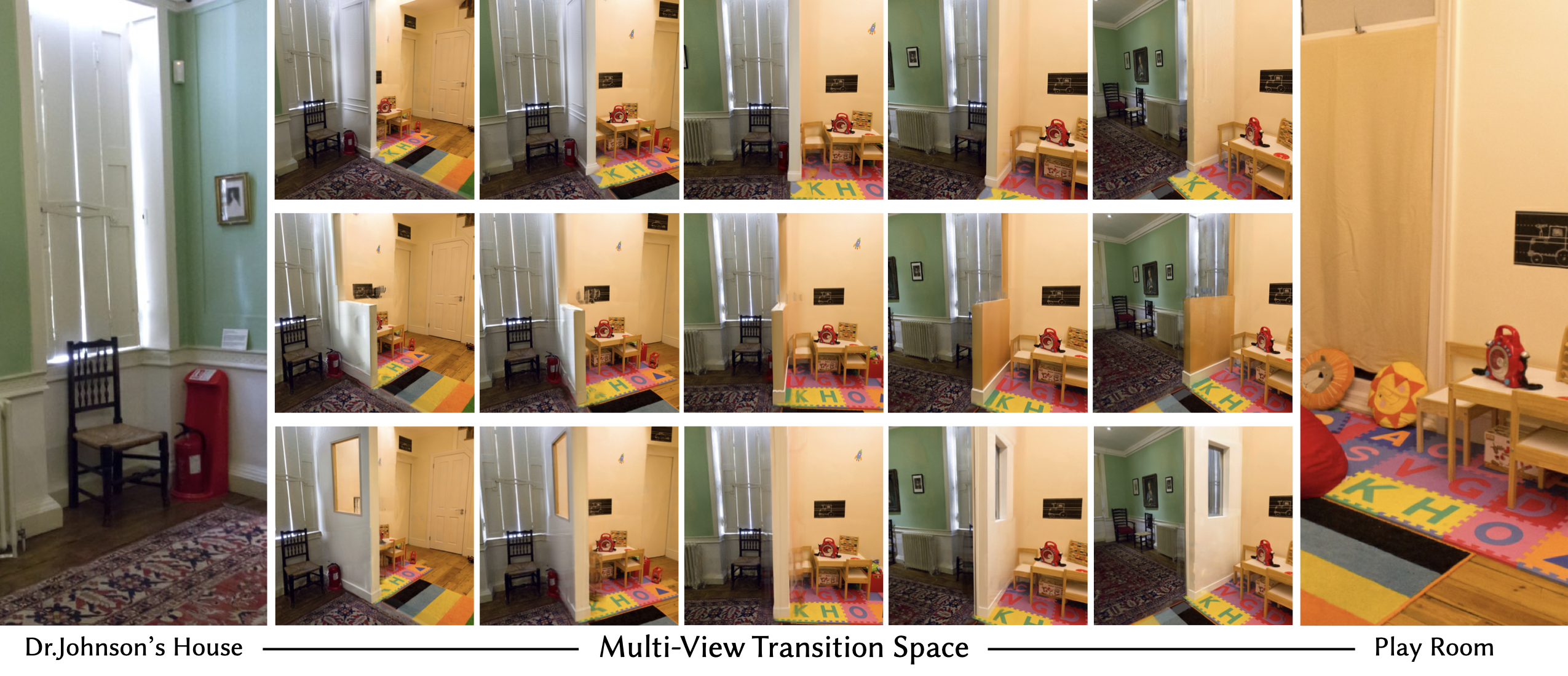
Suppose two rooms are scanned separately. Each is photo-realistic on its own, but nothing was ever captured between them. The missing piece is a transition space: a threshold that mediates between two rooms, deciding how they are experienced as one place. To generate this space, we must hallucinate the middle while keeping the two rooms exactly as captured. Video generation models can imagine a plausible path between two views, but they operate in pixel space rather than metric space. They therefore have no explicit distinction between what has already been captured and what needs to be hallucinated, treating both as equally valid generation targets. As generated content propagates, this can gradually distort the existing geometry and compromise the fidelity of the original scenes.
We introduce TranSpace: a method for generating metric-consistent transition spaces between separately captured indoor scenes. Its core is Progressive Anchoring, which progressively extends the generated region while anchoring each step to the original scene geometry. Each generated frame is composited with geometry rendered from the existing reconstruction (only the transition region is generated, while the rest comes back from the scans) and its camera pose is estimated against that blend. Every pose is therefore measured against real geometry rather than against previously generated content. Pose estimation then works as a quality gate: a frame that cannot be localized reliably is rejected instead of propagated.
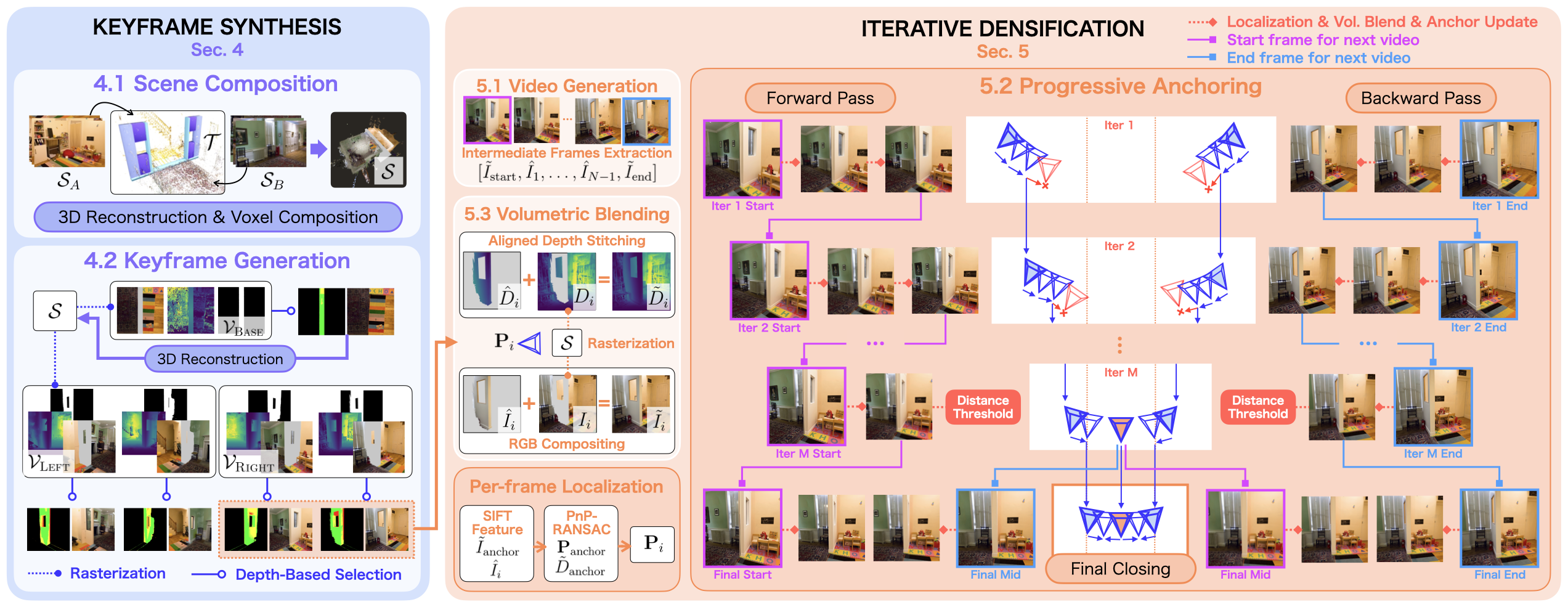
From two reconstructed spaces we compose a unified scene with placeholder voxels defining the transition layout, then inpaint strategic viewpoints to obtain keyframes. Video diffusion densifies these sparse keyframes into continuous sequences. Progressive Anchoring localizes each generated frame against a volumetrically blended anchor so every pose is estimated against pixels that remain grounded in the existing reconstruction. Forward and backward passes grow inward from the two keyframes, and a final closing iteration fills the remaining gap.
We compare against camera-conditioned video generation (SVC [3], Gen3C [4]) and against recovering poses after generation with COLMAP [5], DUSt3R [6], MASt3R [7] and VGGT [8].
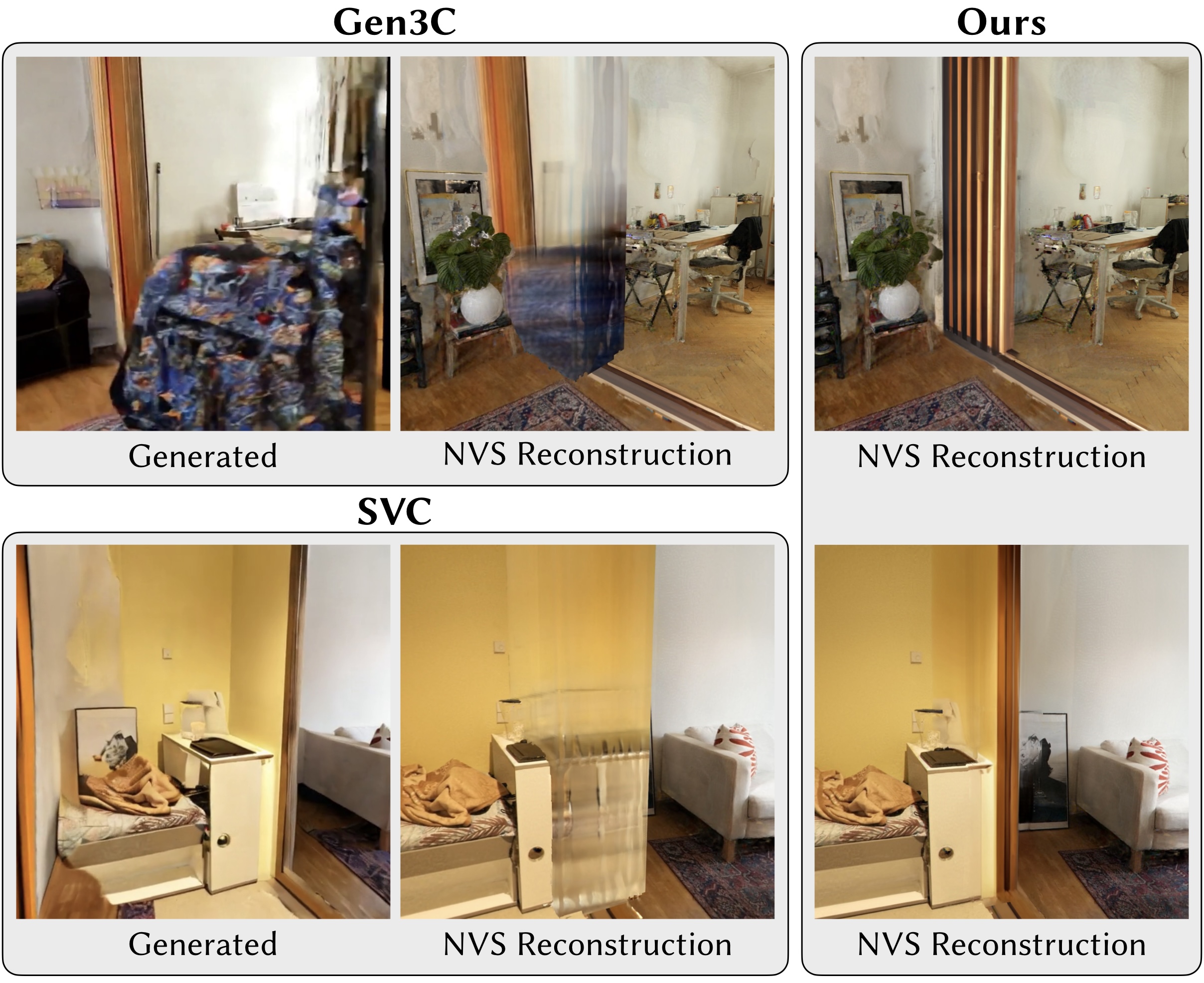
Camera-conditioned generation failures.
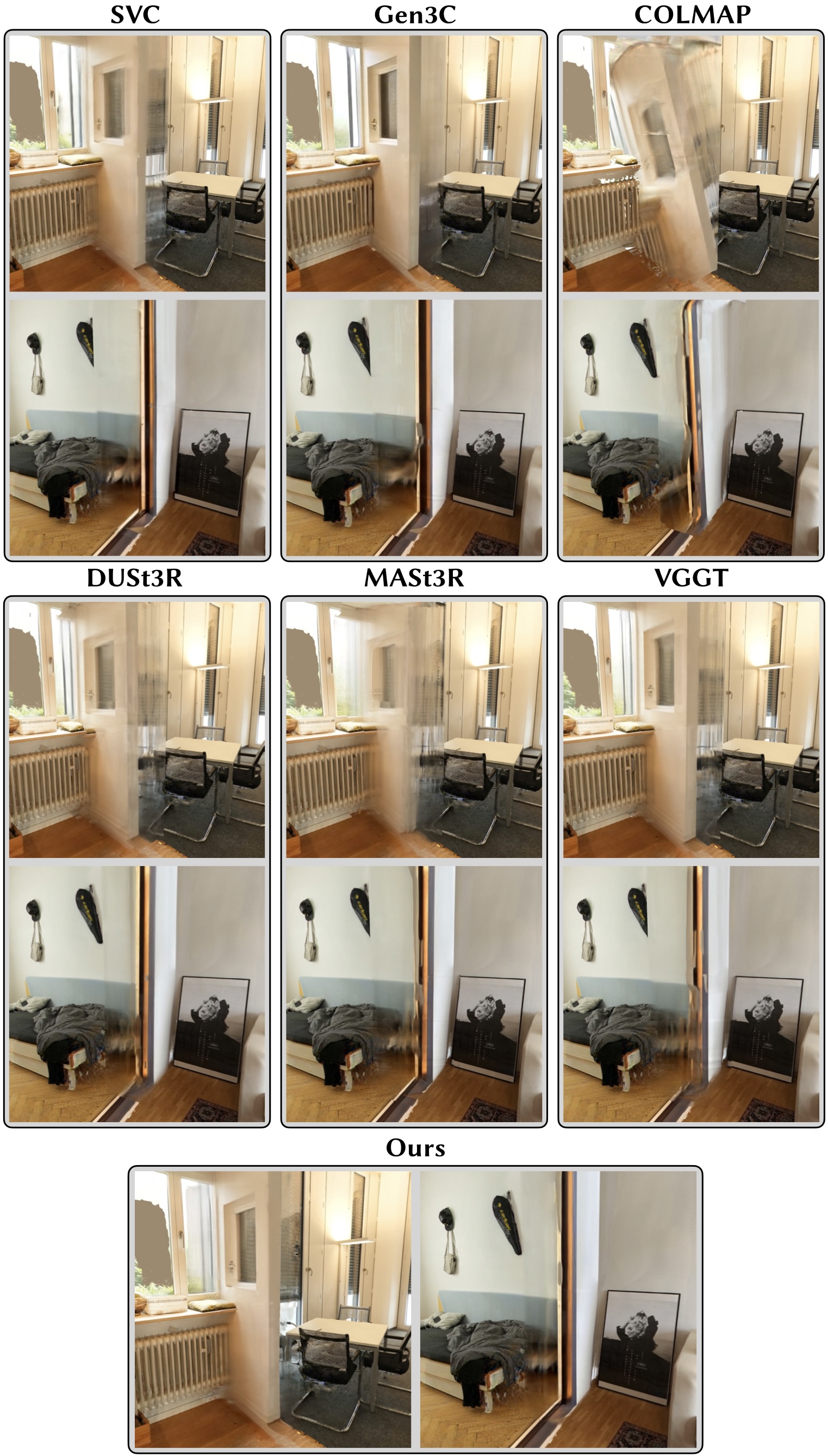
Novel view synthesis reconstructed from each method's output.
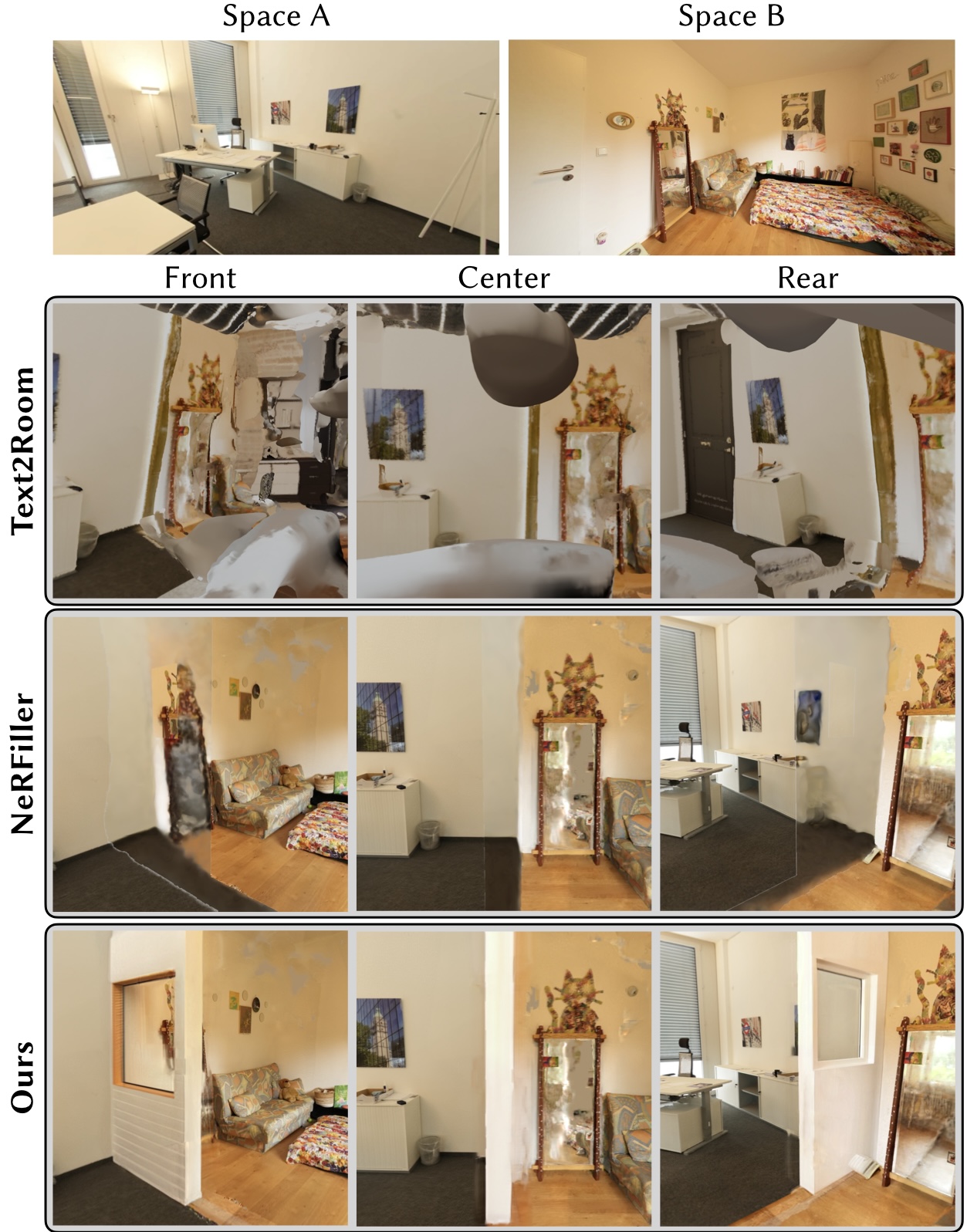
We compare against two room-scale generation methods: Text2Room [9] and NeRFiller [10].
@inproceedings{kim2026transpace,
  title     = {TranSpace: Progressive Anchoring for Metric-Consistent Scene Synthesis},
  author    = {Kim, Hyeshim and Kim, Taehei and Shin, Jihun and Kim, Hyeonjin and Lee, Sung-Hee},
  booktitle = {Proceedings of the 34th ACM International Conference on Multimedia (MM '26)},
  year      = {2026},
  publisher = {ACM},
  doi       = {10.1145/3767308.3836316}
}